
Showing posts with label germany. Show all posts

Jun 11, 2014

This time it is different


It has been a while since I have not written anything on alstria’s blog. I started from time to time, but never get to finish the work. This morning however, when I read the piece about the German real estate, that was featured in the daily newsletter of Property Investor Europe (which is usually the first think I read in the morning), I knew I would get through.
 
The “Expert view”, which is called “Upward trend on the German commercial real estate market” (and available here: http://aox.ag/PIE_German_office ) gives an overview about why investors should be investing in the German office sector, which per see, should not lead to any specific comments from my side. Except that, when I finish reading the post, I suddenly felt younger by 7 to 8 years. If you want a list of all the bad reasons to invest in the German office market, this post is definitely the right place to start. It is making 5 assumptions that should lead a decision to invest in German office space.

Assumption 1: Economic growth in Germany is resulting in increasing demand for office space
This is a graph that was published on this blog four years ago (and would lead to the same result if extended to 2014).
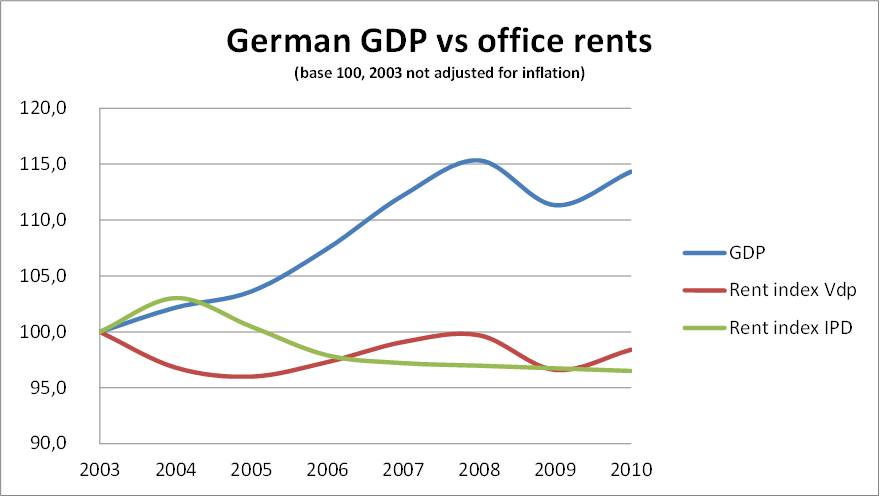
I am amazed to see that some commentators are still arguing about the fact the GDP growth correlate with office rental growth. This might have been the case 30 years ago, but it is clearly not the case anymore. The way tenants are learning to optimize their office space, and the efficiency gain they are realizing are by far outstripping any additional need of space created by GDP growth. Do not expect any substantial rental growth in the German office sector, nor substantial vacancy reduction.  It is unlikely to happen anytime soon.
Assumption 2: Financing of commercial real estate is becoming cheaper
That is absolutely true. Financing is cheap. I would have thought that I would never again hear this as an argument for buying  real estate (nota: alstria always underwrite assets based on unlevered returns), but apparently I was wrong.
Assumption 3: Rising demand for office premises with a positive impact on rental markets
See point one above. This has never happened in the past, and I see no reason why it will happen in the future. Absorption in the market is at best neutral, more realistically negative.
Assumption 4: Ongoing investment pressure is driving transaction volumes and is reducing risk aversion
The first part of the assessment is absolutely correct, investment volume is going up, and has accelerated drastically over the last weeks (mainly on long term leased assets, driven by yield seekers). But I am not sure that risk aversion is reducing. Short term leased assets, or other assets with potential operational risk/leverage are not so much in demand. Not sure though that the risk aversion is reducing, but clearly the risk return profile of some of the assets which are being considered for trading is deteriorating.

So what is the German office market all about then ?
Obviously we all have our views on the market and how it is going to develop, and mine is as good as any other. The fact of the matter is that our position is based on an educated guess, not a crystal ball. We believe that the German office market is going to be driven by operational excellence, vs. financial engineering. That real estate needs more operators and less financial sponsors.  that driving returns should come from increased market share, better scaling of costs, operational excellence, better services to the clients (some call them tenants). That expectation of market rental growth driven by macro factors, should not be considered, and will only enhance returns if its happens. 
In my last roadshow meeting, when I was discussing the state of the investment market and the increased transaction volume we are seeing in Germany, I was asked by an investor if I felt any similarity with 2006-2007. My answer at this point was that I did not, as I believed most of the players in the market still have the deep scares and bad memories of what happened then. I think it is Mark Twain who once said "History does not repeat itself, but it does rhyme". Well PIE this morning was rhyming very strongly with 2007 (and if in doubt here are the same arguments put together in 2007:  

At that time DB concluded as follow:
"The greatest risk in the years ahead therefore lies not in a downswing on the property markets, but in exorbitant expections on the part of investors and project developers"
I guess this last point is still up-to-date


Nov 20, 2012

Adding the numbers


A short mathematical problem for my eight years old son to solve:


·       At 30/09/2011, the total NAV (Net Asset Value)of the German open ended funds was 85.151 mEUR.
·       At 30/09/2012 (a year later) the total NAV  ofthe German open ended funds was 83.173 mEUR

Assuming that over the period the asset value is only influenced by net flows, can you calculate how much theses in(out)flows are ?

Here is my son’s answer (and any other kid for that matter):The total flow for the period is equal 83.173 – 85.151 = - 1.979. Given that this number is negative, this is an OUTFLOW.
You think this is obvious. Well it is not. At least not for the Bundesverband Deutscher Investment-Gesellschaften or BVI. For the German Funds Association which states that “it enforces improvements for fund-investors and promotes equal treatment for all investors in the financial markets. BVI`s investor education programs support students and citizens to improve their financial knowledge”, the simple math above do not work.
According to the BVI the correct answer to the question above is a net INFLOW of EUR 2.766 mEUR. In other words 83.173– 85.151 = +2.766…
This is not an isolated mistake. If you look for the BVI net inflow publications for real estate open ended funds from 2007 to 2011 theses are the numbers you will dig out:
 

While “NET inflow” for the period was around EUR 13.7 b, the total NAV of the funds grew by a little less than a 10th of that. How does this work? 
In order to understand the forces at work, you need to take a look at the same set of numbers, published this time by the Deustche-Bundesbank. The Bundesbank publishes two additional numbers. One is the total outflow, and the second one is the total distribution paid. The Bundesbank also make it crystal clear that the NET-inflow numbers disregard any distribution.
The previous table looks like this in the Bundesbank report:
 
 
With this additional information the numbers make sense (the reason why the numbers do not add-up exactly is because of the underlying performance of the funds which impacts the NAV). The so called Net Inflow, is for the most of it, not more than a dividend re-investment scheme. It has NO influence whatsoever on the amount of money available to invest in real estate.  
The information which is has been provided by the BVI to the market for years is highly misleading. The vast majority of the market participants believe that the net inflow which is publish is what it name says it is: Net inflow, ie. new money that is coming into real estate.  Here are a couple of example of some investors/advisors that have been across the years willingly or not mislead by the BVI communication.
Google will provide you with dozens of other examples. Since the publication of the last BVI figures last week, I have received at least 5 daily emails of investment banks mentioning the fact that open-ended funds had EUR 2,7 b of inflow year to date. All of them were hinting to the fact that this money will need to be invested (at least partly), therefore driving demand. This is just not the case. In actual fact, the total amount of money available for investment in real estate went DOWN.
The BVI recently published an analysis where it found that there are significant deficiencies in the corporate governance of German listed companies. That might as well be true. But assuming the BVI really cares about the topic, I would strongly encourage them to start cracking at their own issues first.
NB: all the numbers quoted in this post are sources from:

Apr 26, 2012

It's a wonderful life


An interesting development in the life of the open-ended fund industry has hit the news today. 

In a press release published today (http://aox.ag/IGAUNd), SEB ImmoInvest is trying to achieve what none of its peers dared to try before. Move from a bank run situation back to a stabilized situation.  They are doing so by pointing on to shareholders the actual consequence of the run. 

The last sentence of the press release that quotes current SEB Asset Management CEO goes as follow: 

Barbara A. Knoflach: “We are asking our investors to consider the alternatives and, by staying invested, to commit to a future of the fund that could very well live up to its successful 23-year track record. The only chance to avoid the liquidation of the fund with all its consequences is not to take advantage of the exit offer.”

I would like to state clearly that this is a very brave move, and indeed, in my view, the only way to put any of the closed funds back into action. 

I have discussed in a previous post the interesting game theory issue that the closure of open-ended fund closure was posing (http://aox.ag/JpQleh). Any one who took the time to run this game would have figured out that this could only work out positively if players increased COOPERATION. This is exactly what SEB is trying to do. Again that is the right thing to do. 

However, I need to point out to one major weakness in the way this is done. There is a lack of clarity on the potential outcomes for each scenario (going concern or liquidation). For cooperation to work and players to see a benefit in cooperation they need to understand that cooperating in the game will lead them to a higher benefit (payout) that acting individually (which in this case end up in a run). While to some extend this is suggested by the press release (the liquidation of the fund AND ALL ITS CONSEQUENCES) it is not explicitly said that a run will probably end up in a much lower payout… To the contrary its insist on the quality of the underlying portfolio as an argument to keep the fund running.  If holders believe that they will get the same value in liquidation than in a going concern, than the cooperation will simply not work. 

I do not know any real life example of any thing like this being done before on such a scale (but would be interested if anyone have any knowledge of this). I can however recall James Steward managing to save its bank with 2.000 dollars in the 1946 It’s a wonderful life movie. Looking back at the scene of the bank run might be a good idea, to understand how he got people to cooperate… http://aox.ag/Ijy0Rn

May 30, 2011

The inconvenient truth

The Association of German Pfandbrief Banks (Verband deutscher Pfandbriefbanken, or vdp) have started a new (welcomed) initiative publishing a German office building rent index. The first result of this index are available on the vdp website (you will find the press release http://aox.ag/mfaQxW , and the index itself http://aox.ag/kkFoxR - theses links are for the English version but the same documents are available on vdp site in German as well).

May 6, 2011

Nash Equilibrium

A number of open ended funds are offering their unit holders a very nice opportunity to make good usage of game theory and figure out what to do next.

Some funds (see related article in the Immobilien Zeitung -in German- http://aox.ag/lvAZK1 ), are asking their current unit holders, what would be their behavior if the funds were to reopen for redemption. The underlying idea, is that the more unit holders opt for redemption, the more likely is the fund to liquidate.

Nov 12, 2010

Hold your fire

We had the question on alstria’s quaterly call this week. Listening to other German real estate companies call, and reading a number of analyst note, it seems that there is a growing number of (non German) market participant who expect “distressed sales” coming from the German open ended funds (mainly of the ones which said they will liquidate).


Is German open ended funds liquidation a great buying opportunity for real estate investor? The answer, is probably no. Or at least not yet.The fund managers have three years to sell their assets. Therefore, they expect that the liquidation is going to be done in an orderly manner, with little “distress” attached to it, and they might as well be right.

Oct 28, 2010

Little Dorrit

Anyone interested in real estate investment is aware of the „difficult“ times the German open ended fund industry is going through. As you can expect the German press is full of article trying to figure out what happened, what a solution would be (may I naively suggest listing?) and whether or not it is safe to invest in them again.

Jul 8, 2010

We (almost) made it happen

News that I felt went through pretty much un-noticed in the last month was the publication of the latest Jones Lang LaSalle transparency index (you can register for free on JLL website and download the study here). For the first time since inception, the German market is part of the “tier 1” countries, along side with the UK, Australia, France and 12 other countries. More precisely Germany is quotes by JLL as the 10th more transparent market among the 81 markets covered by the study, and 6th more transparent among the 34 European market surveyed.

Apr 22, 2010

Ginger Ale

The CMBS market is back. At least so they say. An article in the FT (which can be read here), suggests that a first 350 M€ CMBS was placed in the Netherland. That is real news, as the stall of the CMBS market is clearly one of the main concern still out there. It is becoming mainstream wisdom that there is a large debt overhang coming up, which is to a great part linked to CMBS.

The bizarre part of the press release was linked to the fact that the "CMBS" was rated AAA by all the rating agencies. This looks bizarre as usual CMBS are (use to be) made of different tranches with different rating. I was interested in getting a better understanding of the placement and went to the website of the issuer to see if i could gather additional details (the full press release is available here). And I did. The main information being that this deal was placed as one tranche to a single investor...  Being able to place EUR 350 million of debt in the current market IS an acheivment per say, however, not enough to claim that the CMBS market have reopenned.

Oct 5, 2009

The two fridges syndrome


BREEAM, LEED, HQE or DGNB. Real estate companies and real estate investors should get familiar with these logos and names, as these are the national trademarks for green building respectively in the UK (and international), US (and rest of the world), France, and Germany.

These standards will usually provide a certificate (which can be silver, gold or platinum…) by looking at the building conception and technique and compare it to a “best in class” technology in terms of, amongst others, resource consumption and greenhouse gas emissions.

Sep 4, 2009

Will Aristote save the real estate finance?


In the last 12 months we had numerous questions of investors on what is the Pfandbrief market (the German cover bond market) and how does this market works. I happened to run into an academic study that is a good introduction to the instrument. It is published on the web site of the VdP (Association of German Pfandbrief Banks). The study is dated February 2009, and is called “Refinancing Real Estate Loans – Lessons to be Learned from the Subprime Crisis” (full study can be downloaded following this link).

Jun 12, 2009

Back to the Future


Michael J. Fox driving his DeLorean back and forth in the past and in the future, riding his skateboard, listening to Huey Lewis and the News singing the “Power of Love” was one of my favorite movies. I spent an awful lot of time looking at the VHS video (for those who are younger than 25, VHS tapes were big black boxes with movies of bad quality which you could watch on TV, and TVs at that time were also large boxes with a small screens).

May 18, 2009

Evolution


Real Estate Investment Trust or REIT, is a global trademark which started in the US in the 1960’s, and is now spread across the globe. When a company define itself as a REIT, it mean that it adhere to a number of simple concept. Its is usually a listed company, its business must be real estate investment it is tax transparent, and it pays most of its profit as dividend. Although the local legislation differs here and there, those are the main characteristic of REIT worldwide.

May 14, 2009

Flat Lines


The new value of the IPD/alstria DMX index which measures the reversion potential of German office rents shows for the second consecutive year that, on average, there is little reversion to be expected in the German rental market. (Full IPD study and result can be found here).

This does not come as a surprise to me and hopefully will not surprise any of the investors we are used to speak to, as this is one of the base case assumptions we have been working on since inception.

Apr 28, 2009

Qui va piano va sano


A few weeks ago, following our annual press conference, we got this interesting question from a real estate equity sales desk: “I have one particular question on current disposal talks. If pricing is not very much of an issue and the buyers are mostly equity buyers and have little constraints regarding the debt financing, what is currently holding up the process?

Apr 17, 2009

Apples and bananas

For real estate listed companies like for other industries, March was the month of FY08 earning season and we did publish our numbers on the 31st of March (a replay of the webcast of alstria result presentation can be found here).

Mar 5, 2009

In the credit crunch, the credit might have already left, but the crunch still has to come

In November 2008 a panelist at the ninth annual European Real Estate Opportunity & Private Fund Investing Forum had the following remark: “Is CMBS dead? It can't be dead--there's no other place to get [that money] from” I guess it is relatively fair to say that if CMBS is not clinically dead, it is in a very deep coma.

European real estate markets were less relying on the CMBS market than the US markets. Nevertheless the share of the CMBS market has been constantly growing and it is estimated that more than 20% of the commercial real estate financing was financed through these markets. That still leaves us with a significant number of billions of commercial real estate financed in the CMBS markets…