We have been asked by a number of investor the reason why we have decided not to submit our data to GRESB this year (the data itself is available on our website www.alstria.com/sustainability ).
In order to better explain our position we have used the following presentation.
We are obviously happy to discuss, so please feel free to send us feedback.

Showing posts with label sustainability. Show all posts
Showing posts with label sustainability. Show all posts
Oct 25, 2014


Jan 8, 2013
Socially Responsible Investment

What if one equity research firm
was to send to a company it covers a questionnaire asking specifically for
nonpublic information. This would be done in order to provide its clients with
a “more accurate picture” of the company that what is achievable through public
disclosure. How would the company react? And how would the compliance
department of the research firm react?
You think no one would do that?
Think again. It is done every year for a significant number of companies among
the most respected one. It is done every year by research firm that publish
report about the Corporate Social Responsibility (CSR) of issuers. It is to a
certain extend ironic that these questionnaires will all circle around
corporate governance and compliance issues. In order to fill them, you need to
break one basic rule of corporate governance: Equal treatment of shareholders.
I realized this was the case,
following changes at the GRESB (www.GRESB.com),
a real estate CSR benchmarking non-profit group. We have been submitting data to the GRESB for
the last two years (Our latest answers can be found here http://aox.ag/UzTCzV). What I, and probably a
number of other companies initially overlooked, is that the GRESB is not only a
benchmarking tool. In actual fact the data we would submit to GRESB would be
re-used by GRESB, and fed into (paid?) research, that would be provided to
selected investors.
My first reaction was to write
the GRESB management a letter explaining that I did not felt that this was
appropriate. However, before drafting such a letter I have done some research
about how other do it. The most prominent of theses research firm (as they
provide the research for Footsie4Good) is EIRIS (www.EIRIS.org).
Much to my surprise, they actually openly and specifically mention that they
would ask companies for non-public information. The headline on the company
survey page reads as follow: “The EIRIS
survey is a way for us to get the information that our clients require that
is not already publicly available.” http://www.eiris.org/companies/eiris_survey.html
You might argue that this kind of
information is not relevant for the investment decision. However, it seems
important enough for AXA, BlackRock, and a number of other high profile
investor to pay to get access to this information. It is also interesting to
see that this information will then be available (against payment) on websites
like www.CSRhub.com
Another high profile CSR adviser SAM (which deal with the Dow Jones sustainability index) is less explicit about the nature of the information it asks companies to report on. The website mentions that : "The annual assessment is based on an online questionnaire supported by extensive company documentation" http://www.sam-group.com/en/sustainability-insight/sam-corporate-sustainability-assessment.jsp
Anyway, this does not
seem to have been caught up by any regulator, which tends to demonstrate that
non-financial information is not considered as critical by regulators.
From today on, alstria will
publish on its website the full extent of the questionnaire that we fill up to
these kind of research firms, in order to make sure everyone have access to the
same level of information. I will also still ask GRESB what their position on
the topic is. It might as well be that I have it all wrong.
May 23, 2012
Green Lanterns

IPD has started an interesting
new index in the French market, called the IPD Green Real estate index. It
basically analyses the performance of Green buildings and compares it with both
recent non-green buildings as well as with the general IPD index (http://aox.ag/KdpWzJ)
As far as I know, this is the
first time such an indicator is put together. This is more than welcome
initiative as it might once and for all stop the rhetorical debate about whether
or not Green adds value to the asset.
On the face of it, it looks as if
it does add value. Total return last year for the green building stood at 7,4%.
That is 1,1% higher than equivalent non green building which showed a total
return of 6,3%. However devil is in the details.
Here is how this performance is
broken up:

The green building performance is
solely driven by a (theoretical?) capital value improvement. It relative
performance is very poor in turns of Income Returns with assets yielding around
2% less than the rest of the market. More interestingly the IPD data reveal that
there is no rent difference between Green and non-green buildings (average ERV
is at 356 EUR/sqm/year for non-green vs 361 EUR/sqm/year for green building).
These data allow for an interesting
(theoretical) analysis about the benefit of investing in the green building. Let’s
assume a green office building which is worth 100. According to IPD data, this
asset will generate around 4,2 of rent. Let’s now assume a non-green building
asset generating the same rent. According to IPD this asset is yield 6,3% ie.
is worth 66,7. From there you can derive the actual value as described in the
following table.
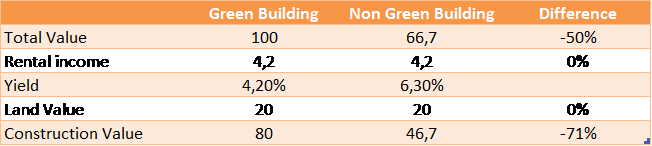
As a result of the IPD data, you
can determine in a few minutes that the market offers a 71% premium for the
value of a “Green” construction over a non-green construction. At this stage it become clear what you want to build if you are a developper. The only economical explanation for such a premium would be that a green building will depreciate much slower than a non-green
building. It would therefore deserve a premium as it would deliver returns on a longuer period of time.
The table below, summarizes the
number of years needed to collect enough rent in order to pay for the
construction cost at a given unlevered expected return (the NPV of the cash
flow is equal to zero).

What the previous table show is that If you expect a 5% return from a non green building, assumes no terminal value, no rental growth, no capex... you need to collect the rent for 16 full years. For a green building for which a 71% premium was paid, you need to collect rent for 54 years. Another way to say this is that the premium reflect the belief that the green building life will be 3,3 times longuer than the non green building.
So now, here is the question:
Which assets do you think is going to generate the most sustainable returns
over time? I am not going to take position. However I have lost faith long ago
in Hal Jordan and the believe that “Green is the color of will”
Apr 10, 2012
To go please !
 I have been trying to figure out
how to improve the utility management process of the company for quite a while
now. This topic is important for us for a number of reasons, and I am deeply
convinced that we need to find the right way to address this while time is
still on our side. Not only managing utilities is the main way to improve
sustainability credential of an asset, but utilities represent the bulk of our
tenant costs. Any extra cents going to utility providers is a cent that we cannot
use to increase the rent. On a longer timeframe consideration, I do believe
that the future of leasing will be (as it is already in some Nordic countries)
in the full service rent were utility costs will be borne by the real estate
owner, rather than by the tenant.
I have been trying to figure out
how to improve the utility management process of the company for quite a while
now. This topic is important for us for a number of reasons, and I am deeply
convinced that we need to find the right way to address this while time is
still on our side. Not only managing utilities is the main way to improve
sustainability credential of an asset, but utilities represent the bulk of our
tenant costs. Any extra cents going to utility providers is a cent that we cannot
use to increase the rent. On a longer timeframe consideration, I do believe
that the future of leasing will be (as it is already in some Nordic countries)
in the full service rent were utility costs will be borne by the real estate
owner, rather than by the tenant.
One of the bigger hurdles
commercial real estate is going through with respect to improved utility
management is in my view the “short” average ownership/management continuity
that drives of industry. As I have argued before, real estate time is much
slower than capital market time. Short ownership for a real estate is in my
view anything between 5 to 7 years. Most of the investment that would be needed
in order to measure and understand what is going on with a building would have
a longer payout period. Without such measurement, and understanding, there is
little you can do. More importantly, it is very unlikely that any buyer of the
asset would pay for this specific piece of technology. The likelihood that a
new owner system would be compatible with yours is very close to zero. The
result is that most real estate owners underinvest into modern tools that would
allow a better grasp on utility bills of building, as they will not capture
enough benefit of the investment over its holding period. I am still confused, that
I am able to know instantly that Lady Gaga changed its dress (@ladygaga on
Twitter), our buildings are not able to communicate real time data. Not that
the technology is lacking, but the cost of the technology is prohibitive within
our potential ownership timeframe.
What we would need is a
technology that would allow us to plug something into an existing metering
system, and then be in position to take that something away with us whenever we
would sell the asset to someone else. This would ease the investment decision,
as the lifetime of the investment would not be tied up to a single asset but to
the “plug and play” device itself. The good news is that there are a bunch of
start-up companies out there that are developing just that. It is early
development stage, lot of progress to be made, but definitively going into the
right direction. We will be looking into that closely to see if it can really
work. Monitoring “to go”, is what we really need. Nov 24, 2010
Aug 18, 2010
Honi soit qui mal y pense

In the foreword to a green supplement in the magazine House and Garden (in 2008), the Prince wrote: "Why, I must ask, does being 'green' mean building with glass and steel and concrete and then adding wind turbines, solar panels, water heaters, sedum roofs, glass atria - all the paraphernalia of a new 'green building industry' - to offset buildings that are inefficient in the first place?
"That many of these add-ons are mere gestures, at best, is now clear, as their impacts on home energy consumption can now be measured and usually offer scant justification for the radical nature of the design." (see http://bit.ly/bjibZy for more on this)
Mar 12, 2010
CETERIS PARIBUS

According to the study, it provides “the first credible evidence on the economic value of the certification of “green buildings”. The release of this report had a great impact and was widely commented by the real estate press (thus my willingness to read the study directly). You might have heard that Green Buildings command a 6% premium on rents and 16% premium on sale price. Well, this is where theses numbers come from.
Mar 7, 2010
Corporate Ethic
Corporate Responsibility and the Environment. This mini-doco by karma production came 3rd in the recent competition sponsored by Australian Ethical in association with the Australian Documentary Foundation.
No comments.
No comments.
Oct 5, 2009
The two fridges syndrome

BREEAM, LEED, HQE or DGNB. Real estate companies and real estate investors should get familiar with these logos and names, as these are the national trademarks for green building respectively in the UK (and international), US (and rest of the world), France, and Germany.
These standards will usually provide a certificate (which can be silver, gold or platinum…) by looking at the building conception and technique and compare it to a “best in class” technology in terms of, amongst others, resource consumption and greenhouse gas emissions.
Subscribe to:
Posts (Atom)