We have been asked by a number of investor the reason why we have decided not to submit our data to GRESB this year (the data itself is available on our website www.alstria.com/sustainability ).
In order to better explain our position we have used the following presentation.
We are obviously happy to discuss, so please feel free to send us feedback.
Showing posts with label green buildings. Show all posts
Showing posts with label green buildings. Show all posts
Oct 25, 2014


May 23, 2012
Green Lanterns

IPD has started an interesting
new index in the French market, called the IPD Green Real estate index. It
basically analyses the performance of Green buildings and compares it with both
recent non-green buildings as well as with the general IPD index (http://aox.ag/KdpWzJ)
As far as I know, this is the
first time such an indicator is put together. This is more than welcome
initiative as it might once and for all stop the rhetorical debate about whether
or not Green adds value to the asset.
On the face of it, it looks as if
it does add value. Total return last year for the green building stood at 7,4%.
That is 1,1% higher than equivalent non green building which showed a total
return of 6,3%. However devil is in the details.
Here is how this performance is
broken up:

The green building performance is
solely driven by a (theoretical?) capital value improvement. It relative
performance is very poor in turns of Income Returns with assets yielding around
2% less than the rest of the market. More interestingly the IPD data reveal that
there is no rent difference between Green and non-green buildings (average ERV
is at 356 EUR/sqm/year for non-green vs 361 EUR/sqm/year for green building).
These data allow for an interesting
(theoretical) analysis about the benefit of investing in the green building. Let’s
assume a green office building which is worth 100. According to IPD data, this
asset will generate around 4,2 of rent. Let’s now assume a non-green building
asset generating the same rent. According to IPD this asset is yield 6,3% ie.
is worth 66,7. From there you can derive the actual value as described in the
following table.
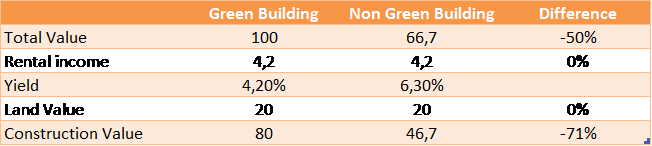
As a result of the IPD data, you
can determine in a few minutes that the market offers a 71% premium for the
value of a “Green” construction over a non-green construction. At this stage it become clear what you want to build if you are a developper. The only economical explanation for such a premium would be that a green building will depreciate much slower than a non-green
building. It would therefore deserve a premium as it would deliver returns on a longuer period of time.
The table below, summarizes the
number of years needed to collect enough rent in order to pay for the
construction cost at a given unlevered expected return (the NPV of the cash
flow is equal to zero).

What the previous table show is that If you expect a 5% return from a non green building, assumes no terminal value, no rental growth, no capex... you need to collect the rent for 16 full years. For a green building for which a 71% premium was paid, you need to collect rent for 54 years. Another way to say this is that the premium reflect the belief that the green building life will be 3,3 times longuer than the non green building.
So now, here is the question:
Which assets do you think is going to generate the most sustainable returns
over time? I am not going to take position. However I have lost faith long ago
in Hal Jordan and the believe that “Green is the color of will”
Apr 4, 2011
Aug 18, 2010
Honi soit qui mal y pense

In the foreword to a green supplement in the magazine House and Garden (in 2008), the Prince wrote: "Why, I must ask, does being 'green' mean building with glass and steel and concrete and then adding wind turbines, solar panels, water heaters, sedum roofs, glass atria - all the paraphernalia of a new 'green building industry' - to offset buildings that are inefficient in the first place?
"That many of these add-ons are mere gestures, at best, is now clear, as their impacts on home energy consumption can now be measured and usually offer scant justification for the radical nature of the design." (see http://bit.ly/bjibZy for more on this)
Mar 12, 2010
CETERIS PARIBUS

According to the study, it provides “the first credible evidence on the economic value of the certification of “green buildings”. The release of this report had a great impact and was widely commented by the real estate press (thus my willingness to read the study directly). You might have heard that Green Buildings command a 6% premium on rents and 16% premium on sale price. Well, this is where theses numbers come from.
Mar 7, 2010
Corporate Ethic
Corporate Responsibility and the Environment. This mini-doco by karma production came 3rd in the recent competition sponsored by Australian Ethical in association with the Australian Documentary Foundation.
No comments.
No comments.
Oct 5, 2009
The two fridges syndrome

BREEAM, LEED, HQE or DGNB. Real estate companies and real estate investors should get familiar with these logos and names, as these are the national trademarks for green building respectively in the UK (and international), US (and rest of the world), France, and Germany.
These standards will usually provide a certificate (which can be silver, gold or platinum…) by looking at the building conception and technique and compare it to a “best in class” technology in terms of, amongst others, resource consumption and greenhouse gas emissions.
Subscribe to:
Posts (Atom)