A real estate analyst recently wrote that “In the real estate industry especially, buy and hold investment approaches are in essence simple spread businesses. Spread means the difference between rental yields (in our example we took gross rental yield based on in place rents) and the cost of interest-bearing debt (CoD).”
This vision of real estate is as far as reality as one can be, and ignores that running a (permanent) real estate business is much more an operational task than a financial gimmick.
Ignoring the physical reality of a real estate asset (it is depreciating over time, and need much care an attention), is a proven recipe for disaster, and had led not so long ago to a substantial amount of tears.
Our approach to real estate is for and foremost operational. Our underwriting of real estate is unlevered, in order not to cloud our judgment with cheap debt, and easy money. alstria will benefit from the low interest rate environment in the future, and the implied increased carry on our assets. However, this is done on assets which have an intrinsic value, beyond the cheap cost of funding. This value is underpinned by business plan that rely on reasonable market assumption, and more importantly on the ability to implement this business plans. Not on the biggest fool theory.
This approach has allowed us to increase our FFO per share systematically over the last 5 years, and allows us yet again to guide to an increase for the year to come. Achieving this result was possible thanks to a strong investment in our real estate operations, the dedication of our people to operation of the assets and the emphasis we put on our sticking to our strict underwriting criteria. We see no reason to change this approach, as we believe this is the only sustainable way forward. Carry trade in real estate is a dead wrong approach.
Jan 16, 2015
Dead wrong
Labels:
accounting,
carry,
governance,
Hamburg,
IFRS,
interest rates,
investment,
real estate,
trade,
yields
Oct 25, 2014
The #GRESB Conundrum
We have been asked by a number of investor the reason why we have decided not to submit our data to GRESB this year (the data itself is available on our website www.alstria.com/sustainability ).
In order to better explain our position we have used the following presentation.
We are obviously happy to discuss, so please feel free to send us feedback.
In order to better explain our position we have used the following presentation.
We are obviously happy to discuss, so please feel free to send us feedback.
Labels:
building,
CSR,
environment,
green,
green buildings,
GRESB,
investor,
IR,
real estate,
reit,
relation,
responsible,
sustainability
Jun 11, 2014
This time it is different
It has been a while since I have not written anything on alstria’s blog. I started from time to time, but never get to finish the work. This morning however, when I read the piece about the German real estate, that was featured in the daily newsletter of Property Investor Europe (which is usually the first think I read in the morning), I knew I would get through.
The “Expert view”, which is
called “Upward trend on
the German commercial real estate market” (and available here: http://aox.ag/PIE_German_office
) gives an overview about why investors should be investing in the German
office sector, which per see, should not lead to any specific comments from my
side. Except that, when I finish reading the post, I suddenly felt younger by 7
to 8 years. If you want a list of all the bad reasons to invest in the German
office market, this post is definitely the right place to start. It is making 5
assumptions that should lead a decision to invest in German office space.
Assumption 1: Economic
growth in Germany is resulting in increasing demand for office space
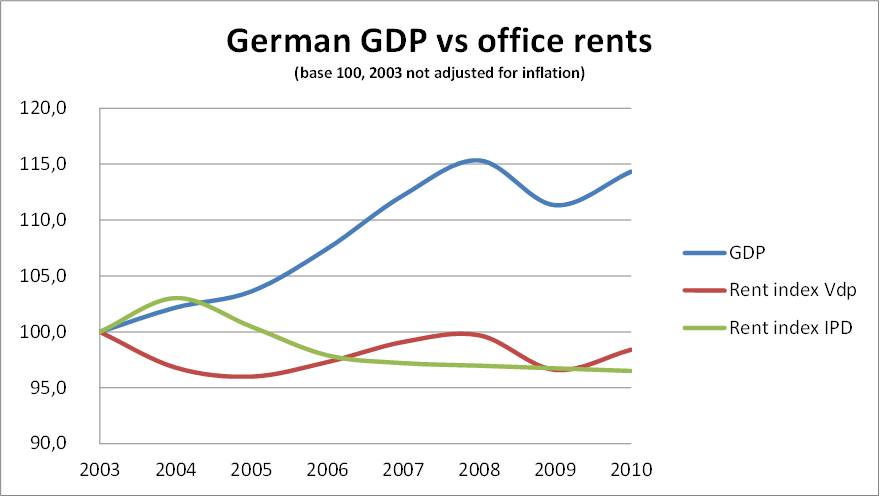
This is a graph that was
published on this blog four years ago (and would lead to the same result if
extended to 2014).
I am amazed to see that
some commentators are still arguing about the fact the GDP growth correlate with
office rental growth. This might have been the case 30 years ago, but it is
clearly not the case anymore. The way tenants are learning to optimize their
office space, and the efficiency gain they are realizing are by far outstripping
any additional need of space created by GDP growth. Do not expect any substantial
rental growth in the German office sector, nor substantial vacancy reduction. It is unlikely to happen anytime soon.
Assumption 2: Financing of
commercial real estate is becoming cheaper
That is absolutely true.
Financing is cheap. I would have thought that I would never again hear this as
an argument for buying real estate (nota: alstria always underwrite assets
based on unlevered returns), but apparently I was wrong.
Assumption 3: Rising
demand for office premises with a positive impact on rental markets
See point one above. This has
never happened in the past, and I see no reason why it will happen in the
future. Absorption in the market is at best neutral, more realistically negative.
Assumption 4: Ongoing
investment pressure is driving transaction volumes and is reducing risk
aversion
The first part of the assessment is
absolutely correct, investment volume is going up, and has accelerated drastically
over the last weeks (mainly on long term leased assets, driven by yield
seekers). But I am not sure that risk aversion is reducing. Short term leased
assets, or other assets with potential operational risk/leverage are not so
much in demand. Not sure though that the risk aversion is reducing, but clearly
the risk return profile of some of the assets which are being considered for
trading is deteriorating.
So what is the German office market all about then ?
Obviously we all have our views
on the market and how it is going to develop, and mine is as good as any other.
The fact of the matter is that our position is based on an educated guess, not a crystal ball. We
believe that the German office market is going to be driven by operational excellence,
vs. financial engineering. That real estate needs more operators and less
financial sponsors. that driving returns should come from increased market share, better scaling of costs, operational excellence, better services to the clients (some call them tenants). That expectation of market rental growth driven by macro factors, should not be considered, and will only enhance returns if its happens.
In my last roadshow meeting, when
I was discussing the state of the investment market and the increased
transaction volume we are seeing in Germany, I was asked by an investor if I felt
any similarity with 2006-2007. My answer at this point was that I did not, as I
believed most of the players in the market still have the deep scares and bad memories
of what happened then. I think it is Mark Twain who once said "History does not repeat itself, but it does rhyme". Well PIE this morning was rhyming very strongly with 2007 (and if in doubt here are the same arguments put together in 2007:
At that time DB concluded as follow:
"The greatest risk in the years ahead therefore lies not in a downswing on the property markets, but in exorbitant expections on the part of investors and project developers"
I guess this last point is still up-to-date
Labels:
alstria,
capital,
crisis,
equity,
europe,
german,
germany,
increase,
investment,
investor,
real,
real estate,
reit,
transactions,
valuation
Jan 8, 2013
Socially Responsible Investment
What if one equity research firm
was to send to a company it covers a questionnaire asking specifically for
nonpublic information. This would be done in order to provide its clients with
a “more accurate picture” of the company that what is achievable through public
disclosure. How would the company react? And how would the compliance
department of the research firm react?
You think no one would do that?
Think again. It is done every year for a significant number of companies among
the most respected one. It is done every year by research firm that publish
report about the Corporate Social Responsibility (CSR) of issuers. It is to a
certain extend ironic that these questionnaires will all circle around
corporate governance and compliance issues. In order to fill them, you need to
break one basic rule of corporate governance: Equal treatment of shareholders.
I realized this was the case,
following changes at the GRESB (www.GRESB.com),
a real estate CSR benchmarking non-profit group. We have been submitting data to the GRESB for
the last two years (Our latest answers can be found here http://aox.ag/UzTCzV). What I, and probably a
number of other companies initially overlooked, is that the GRESB is not only a
benchmarking tool. In actual fact the data we would submit to GRESB would be
re-used by GRESB, and fed into (paid?) research, that would be provided to
selected investors.
My first reaction was to write
the GRESB management a letter explaining that I did not felt that this was
appropriate. However, before drafting such a letter I have done some research
about how other do it. The most prominent of theses research firm (as they
provide the research for Footsie4Good) is EIRIS (www.EIRIS.org).
Much to my surprise, they actually openly and specifically mention that they
would ask companies for non-public information. The headline on the company
survey page reads as follow: “The EIRIS
survey is a way for us to get the information that our clients require that
is not already publicly available.” http://www.eiris.org/companies/eiris_survey.html
You might argue that this kind of
information is not relevant for the investment decision. However, it seems
important enough for AXA, BlackRock, and a number of other high profile
investor to pay to get access to this information. It is also interesting to
see that this information will then be available (against payment) on websites
like www.CSRhub.com
Another high profile CSR adviser SAM (which deal with the Dow Jones sustainability index) is less explicit about the nature of the information it asks companies to report on. The website mentions that : "The annual assessment is based on an online questionnaire supported by extensive company documentation" http://www.sam-group.com/en/sustainability-insight/sam-corporate-sustainability-assessment.jsp
Anyway, this does not
seem to have been caught up by any regulator, which tends to demonstrate that
non-financial information is not considered as critical by regulators.
From today on, alstria will
publish on its website the full extent of the questionnaire that we fill up to
these kind of research firms, in order to make sure everyone have access to the
same level of information. I will also still ask GRESB what their position on
the topic is. It might as well be that I have it all wrong.
Labels:
CSR,
EIRIS,
GRESB,
insider,
real estate,
shareholders,
SRI,
sustainability,
trading,
transparency
Dec 21, 2012
Life Insurance
The say on the street is that
there is a funding gap in the European property market. The say is also that
new players are coming along to fill, or benefit from this gap. These new
players are called debt funds, or insurance companies. Reports are piling up
announcing the raise of new funds, or the billions that this or this insurance
company is planning to invest in the new yield Eldorado. Advisors are warning
about banking regulation risks looming on the new sector, and offering advice… And
journalist have been writing about it (for instance here http://aox.ag/12tjxdn, here http://aox.ag/12tjw9c and here http://aox.ag/TbXMdh )
I have been wondering how much of
all of this is actually for real, and how much is there to help us sleep at
night. The white knights are coming to save our industry from its own cliff.
The fact is that there are a
number of high profile loans which have been put together by insurance
companies (not so much by funds so far). The Deutsche Bank and the Silber
Towers in Frankfurt, some prime assets in London… So there is some action going
in there. But is that really new? In the syndicated facility of alstria back in
2007 we also had AXA as part of the consortium with one of its debt fund
(alongside with 25 banks). Today we do have a fund from Deka as part of our
banking syndicate.
We also hear that unlike in the
US, insurance companies have never really be involved in the financing of real
estate in Europe. This is not exactly true. The lion share of the Pfandbrief
bonds (the German cover bond market which finance real estate across Europe)
are actually sold to insurance companies (although we could not identify any statistic
in that respect). According to the Vdp, the total amount of Pfandbrief loan
outstanding in Europe at the end of 2011 was around EUR 297 billion. The
pfandbrief banks granted EUR 90 billion of new real estate loan in 2011. This
compares with, for instance, Allianz target of EUR 5 billion loan book by 2015 (
http://aox.ag/UhbZHW )or the total EUR 2
billion of new loans by insurance companies in 2011…
From my perspective, the key
question in this debate is not really whether or not insurance companies will
step in the lending business. But are they going to do this with new capital,
or is the lending business just part of the existing real estate allocation. GE
Real Estate for instance (which I appreciate is not an insurance company, see
here http://aox.ag/T3EytC ) is stepping out
of equity, and coming back into debt. Net net, the move is neutral… No new
capital.
Labels:
allianz,
covered bond,
debt,
equity,
europe,
insurance,
life,
pfandbrief,
real estate,
reit
Nov 20, 2012
Adding the numbers

A short mathematical problem for my eight years old son to solve:
· At 30/09/2011, the total NAV (Net Asset Value)of the German open ended funds was 85.151 mEUR.
Assuming that over the period the asset value is only influenced by net flows, can you calculate how much theses in(out)flows are ?
Here is my son’s answer (and any other kid for that matter):The total flow for the period is equal 83.173 – 85.151 = - 1.979. Given that this number is negative, this is an OUTFLOW.
You think this is obvious. Well it is not. At least not for the Bundesverband Deutscher Investment-Gesellschaften or BVI. For the German Funds Association which states that “it enforces improvements for fund-investors and promotes equal treatment for all investors in the financial markets. BVI`s investor education programs support students and citizens to improve their financial knowledge”, the simple math above do not work.
According to the BVI the correct answer to the question above is a net INFLOW of EUR 2.766 mEUR. In other words 83.173– 85.151 = +2.766…
This is not an isolated mistake. If you look for the BVI net inflow publications for real estate open ended funds from 2007 to 2011 theses are the numbers you will dig out:
While “NET inflow” for the period was around EUR 13.7 b, the total NAV of the funds grew by a little less than a 10th of that. How does this work?
In order to understand the forces at work, you need to take a look at the same set of numbers, published this time by the Deustche-Bundesbank. The Bundesbank publishes two additional numbers. One is the total outflow, and the second one is the total distribution paid. The Bundesbank also make it crystal clear that the NET-inflow numbers disregard any distribution.
The previous table looks like this in the Bundesbank report:

With this additional information the numbers make sense (the reason why the numbers do not add-up exactly is because of the underlying performance of the funds which impacts the NAV). The so called Net Inflow, is for the most of it, not more than a dividend re-investment scheme. It has NO influence whatsoever on the amount of money available to invest in real estate.
The information which is has been provided by the BVI to the market for years is highly misleading. The vast majority of the market participants believe that the net inflow which is publish is what it name says it is: Net inflow, ie. new money that is coming into real estate. Here are a couple of example of some investors/advisors that have been across the years willingly or not mislead by the BVI communication.
Google will provide you with dozens of other examples. Since the publication of the last BVI figures last week, I have received at least 5 daily emails of investment banks mentioning the fact that open-ended funds had EUR 2,7 b of inflow year to date. All of them were hinting to the fact that this money will need to be invested (at least partly), therefore driving demand. This is just not the case. In actual fact, the total amount of money available for investment in real estate went DOWN.
The BVI recently published an analysis where it found that there are significant deficiencies in the corporate governance of German listed companies. That might as well be true. But assuming the BVI really cares about the topic, I would strongly encourage them to start cracking at their own issues first.
NB: all the numbers quoted in this post are sources from:
http://www.bundesbank.de/Navigation/EN/Publications/Statistical_supplements/statistical_supplements.html (supplement 2 as of 28/09/2012)
May 23, 2012
Green Lanterns
IPD has started an interesting
new index in the French market, called the IPD Green Real estate index. It
basically analyses the performance of Green buildings and compares it with both
recent non-green buildings as well as with the general IPD index (http://aox.ag/KdpWzJ)
As far as I know, this is the
first time such an indicator is put together. This is more than welcome
initiative as it might once and for all stop the rhetorical debate about whether
or not Green adds value to the asset.
On the face of it, it looks as if
it does add value. Total return last year for the green building stood at 7,4%.
That is 1,1% higher than equivalent non green building which showed a total
return of 6,3%. However devil is in the details.
Here is how this performance is
broken up:
The green building performance is
solely driven by a (theoretical?) capital value improvement. It relative
performance is very poor in turns of Income Returns with assets yielding around
2% less than the rest of the market. More interestingly the IPD data reveal that
there is no rent difference between Green and non-green buildings (average ERV
is at 356 EUR/sqm/year for non-green vs 361 EUR/sqm/year for green building).
These data allow for an interesting
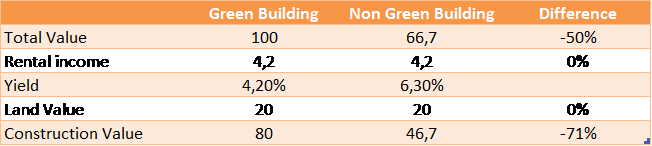
(theoretical) analysis about the benefit of investing in the green building. Let’s
assume a green office building which is worth 100. According to IPD data, this
asset will generate around 4,2 of rent. Let’s now assume a non-green building
asset generating the same rent. According to IPD this asset is yield 6,3% ie.
is worth 66,7. From there you can derive the actual value as described in the
following table.
As a result of the IPD data, you
can determine in a few minutes that the market offers a 71% premium for the
value of a “Green” construction over a non-green construction. At this stage it become clear what you want to build if you are a developper. The only economical explanation for such a premium would be that a green building will depreciate much slower than a non-green
building. It would therefore deserve a premium as it would deliver returns on a longuer period of time.
The table below, summarizes the
number of years needed to collect enough rent in order to pay for the
construction cost at a given unlevered expected return (the NPV of the cash
flow is equal to zero).
What the previous table show is that If you expect a 5% return from a non green building, assumes no terminal value, no rental growth, no capex... you need to collect the rent for 16 full years. For a green building for which a 71% premium was paid, you need to collect rent for 54 years. Another way to say this is that the premium reflect the belief that the green building life will be 3,3 times longuer than the non green building.
So now, here is the question:
Which assets do you think is going to generate the most sustainable returns
over time? I am not going to take position. However I have lost faith long ago
in Hal Jordan and the believe that “Green is the color of will”
Labels:
DGNB,
green buildings,
IPD,
listed companies,
market,
MIS-LEED-ING,
real estate,
reit,
sustainability,
transparency
Apr 26, 2012
It's a wonderful life
An interesting development in the life of the open-ended fund industry has hit the news today.
In a press release published today (http://aox.ag/IGAUNd), SEB ImmoInvest is trying to achieve what none of its peers dared to try before. Move from a bank run situation back to a stabilized situation. They are doing so by pointing on to shareholders the actual consequence of the run.
The last sentence of the press release that quotes current SEB Asset Management CEO goes as follow:
Barbara A. Knoflach: “We are asking our investors to consider the alternatives and, by staying invested, to commit to a future of the fund that could very well live up to its successful 23-year track record. The only chance to avoid the liquidation of the fund with all its consequences is not to take advantage of the exit offer.”
I would like to state clearly that this is a very brave move, and indeed, in my view, the only way to put any of the closed funds back into action.
I have discussed in a previous post the interesting game theory issue that the closure of open-ended fund closure was posing (http://aox.ag/JpQleh). Any one who took the time to run this game would have figured out that this could only work out positively if players increased COOPERATION. This is exactly what SEB is trying to do. Again that is the right thing to do.
However, I need to point out to one major weakness in the way this is done. There is a lack of clarity on the potential outcomes for each scenario (going concern or liquidation). For cooperation to work and players to see a benefit in cooperation they need to understand that cooperating in the game will lead them to a higher benefit (payout) that acting individually (which in this case end up in a run). While to some extend this is suggested by the press release (the liquidation of the fund AND ALL ITS CONSEQUENCES) it is not explicitly said that a run will probably end up in a much lower payout… To the contrary its insist on the quality of the underlying portfolio as an argument to keep the fund running. If holders believe that they will get the same value in liquidation than in a going concern, than the cooperation will simply not work.
I do not know any real life example of any thing like this being done before on such a scale (but would be interested if anyone have any knowledge of this). I can however recall James Steward managing to save its bank with 2.000 dollars in the 1946 It’s a wonderful life movie. Looking back at the scene of the bank run might be a good idea, to understand how he got people to cooperate… http://aox.ag/Ijy0Rn.
Labels:
game,
germany,
Open Ended Funds,
theory
Apr 20, 2012
Forward looking statement
An interesting white paper published
recently by Collier International went un-noticed, while I believe it deserve
some attention and reading by anyone who is interested in the European office
market.
The white paper is the third
issue of a series called “Generation Y: Space planning and the future of
workplace design”. Below this (un)inspiring title lies an interesting tentative
calculation of the future demand for space in Europe (full document: http://aox.ag/Jyf8cg)
Collier equation is quite simple.
They consider office workers population trend considering population growth,
and remote working trends, as well as new workspace design trends, and add up
the numbers.
The result of this analysis for
an office hosting 200 employee in 2012 is summarized in the table below:
The methodology used by Colliers
can clearly be questioned. It is rather simplistic, and I am sure any academic
can come up with a much more sophisticated econometric model in order to try to
assess the need for office use in the future. However, the mere fact that it is
simple does not means that it is pointing into the wrong direction.
In fact this analysis fit
relatively well in the empirical evidence we have been gathering for years from
the market. The existing building environment for commercial office space is
sufficient in all the advanced economy. We do not need to build new space, but
need to improve the existing one to fit better standards. Local government will
have a significant responsibility as by granting building permits to build new
office space. If in parallel they do not act to remove the same amount of space
elsewhere, they are slowly but surely planting the seed for future vacancy. If
in doubt you can have a look at the Nederland, or certain cities in Eastern
Germany…
We have also argued in the past
that this trend should not necessarily be considered as a bad trend for listed
real estate company. Business models will surely need to adapt. Just being
there is likely not to be enough anymore. None of the existing office property
company anywhere in Europe has such a dominant market share, that it actually
needs a growing market in order to pursue it own growth. It is however very
likely that capital alone is not going to do the trick anymore. Emphasis is
going to move slowly but surely from capital to operation. Listed companies are
usually better prepared to face these challenges, than any other player in the
market. They usually integrate the full real estate value change and can
therefore identify change earlier than others and react faster.
The move is happening as we speak. As usual in
our industry it is happening slowly. Don’t be mistaken by the lack of wave on
the surface, this change is fundamental. I do not know whether or not Colliers is
right in estimating the numbers of sqm of office space that will be needed in
the future. However I do know that whoever will do my job in 2030, will be facing
a completely different industry. With hopefully a number of more professional
and bigger listed real estate companies.
Apr 17, 2012
Point of view
Following the publication of our
latest annual reports we had a number of discussions with some analysts and
investors (as we did last year for that matter) with respect to the write-off
in value that we have published on our short leased assets.
We usually argue that from our
perspective we would offer a lower price for a vacant building than we would
for the same asset with a one year lease, which in turn should be cheaper than
the same building with a two years lease … We always felt it makes a lot of
sense to reflect this into our valuation process, and thus devalue every year
the short dated assets to reflect the shorter lease term.
A recent article published by
property magazine international (http://aox.ag/Ii71mp)
is bringing a new perspective to the subject, based on a recent IPD analysis (this is the IPD Press release http://aox.ag/HVdOBX).
According to IPD (as quoted by
the article), UK landlords who give tenants five years leases immediately wipe
out almost 2% of the value of their building.
Quote: “IPD lease length analysis shows
that signing a new five year lease leads to a fall in value of around -1.8%,
despite the property being let.”
Let’s all take a deep breath and
step back for a minute to look closer to what IPS is suggesting here? If I read
this correctly, the valuation of building which have signed a new five year
lease (so which obviously were vacant or closed to be vacant) have LOST value
because of the new lease. In other word, if investors would have paid 100 for a
vacant building, they would only pay 98 for the same building with a five year
lease. In essence, you would be better off keeping the asset vacant, rather
than signing a short term lease. I don’t know about you, but this does not pass
my smell test.
I might have a very twisted mind,
but I would like to suggest another explanation for the whole story. What if
the initial valuation of the building was wrong? What if the asset was never
worth 100 in the first place? What if the new lease has shown beyond dispute
that the assumption to get to the 100 value cannot be hold on to? Can it be
that if the building was initially worth only 90 or 95, then the 5 year lease
did increase the value to 98?
From where I stand, in 99% of the
cases, a cash flow producing asset is going to be worth more than the same
asset vacant. Regardless of the length of the cash-flow. As such, we do devalue
our assets when they are close of becoming vacant and we do show an increase in
value when leases are renewed.
Where do you stand?
Labels:
IPD,
real,
real estate,
rent,
rental growt,
valuation
Apr 10, 2012
To go please !
I have been trying to figure out
how to improve the utility management process of the company for quite a while
now. This topic is important for us for a number of reasons, and I am deeply
convinced that we need to find the right way to address this while time is
still on our side. Not only managing utilities is the main way to improve
sustainability credential of an asset, but utilities represent the bulk of our
tenant costs. Any extra cents going to utility providers is a cent that we cannot
use to increase the rent. On a longer timeframe consideration, I do believe
that the future of leasing will be (as it is already in some Nordic countries)
in the full service rent were utility costs will be borne by the real estate
owner, rather than by the tenant.
One of the bigger hurdles
commercial real estate is going through with respect to improved utility
management is in my view the “short” average ownership/management continuity
that drives of industry. As I have argued before, real estate time is much
slower than capital market time. Short ownership for a real estate is in my
view anything between 5 to 7 years. Most of the investment that would be needed
in order to measure and understand what is going on with a building would have
a longer payout period. Without such measurement, and understanding, there is
little you can do. More importantly, it is very unlikely that any buyer of the
asset would pay for this specific piece of technology. The likelihood that a
new owner system would be compatible with yours is very close to zero. The
result is that most real estate owners underinvest into modern tools that would
allow a better grasp on utility bills of building, as they will not capture
enough benefit of the investment over its holding period. I am still confused, that
I am able to know instantly that Lady Gaga changed its dress (@ladygaga on
Twitter), our buildings are not able to communicate real time data. Not that
the technology is lacking, but the cost of the technology is prohibitive within
our potential ownership timeframe.
What we would need is a
technology that would allow us to plug something into an existing metering
system, and then be in position to take that something away with us whenever we
would sell the asset to someone else. This would ease the investment decision,
as the lifetime of the investment would not be tied up to a single asset but to
the “plug and play” device itself. The good news is that there are a bunch of
start-up companies out there that are developing just that. It is early
development stage, lot of progress to be made, but definitively going into the
right direction. We will be looking into that closely to see if it can really
work. Monitoring “to go”, is what we really need.
Labels:
alstria,
DGNB,
office,
real estate,
real time,
sustainability
Feb 16, 2012
More than a thousand words
This is probably not really worth a press release, but i though I could take a few minutes to write about it on our blog. Our AltePost development project has been selected to run for the MIPIM award in two categories this year. As the best Refurbished Building, and the Best German Project.
It is a very nice recognition for what was a five year hard work for our team as well as our partners (although for them it was only three years work). This development is one of which a young company like alstria can be proud of. It demonstates that you can acheive eventually please a lot of people with divergent interest, as long as you have the right approach and the right asset.
The first stakeholders of this development where the citizen of Hamburg which were concerned about the look and feel of the area shaped around this asset. This concern was convayed to a certain extend by the Monument Protection authorities that insisted on a number of things to be done. As a developper you usually hate this, but as a citizen, they did a great job. Just looking at the people wandering around the asset, and looking at its new design is a testimony of the successful repositioning of this lamdmark asset in the heart of both the City and its citizens.
Tenant are also by definition large stakeholders, and the challenge of bringing this asset to modernity while keeping it 170 years old soul, was acheived successfully as testified by the fast leasing success of the asset and the unique quality of its tenant base.
And last but not least, our shareholders and the one of our partners also had a vested interest in this project. In essence you can easily acheive to satisfy the first two stakeholders above, if you spend enough money on the building. In the case of AltePost, the result yielded to our shareholders where also outstanding.
Theses results where only acheived through the work of the project team of this development which involved us, and our partners Quantum and Stenham. Market movements had nothing to do with the success of this project. It is also a testimony of what we stand for and what we believe in. Real estate is about work. Do not expect market to help you to grow. Growth only comes through hard, usually long, and alway exiting work.
All in all this project explains more than a thousand words how our approach to real estate management.
Sep 30, 2011
I love it when a plan comes together!
European leaders might or might
not be putting together CDO² in order to save (or kill for that matter) the
Eurozone. The ECB might or might not become a large hedge fund. European banks
might be under-capitalized (from what we can see it is fair to say that at
least their real estate loan book is nowhere close where it would need to be).
The US are facing huge budgets constrains while US politics seem just as
reliable as Europeans. Maybe, or maybe not, but there is nothing much we can do
about all of this.
So from this perspective the current situation and the concern around debt availability should not really come as a surprise. We have successfully used the three previous years to reduce debt level on the company’s balance sheet, and reinforce its operational capability. We were expecting a bumpy ride. So we are very confident when it comes to sailing into the bumpy weather.
I used to love the A-tean when i was a kid. Even when it all looked very bad, every episode ended with Hannibal saying : "I love it when a plan comes together!". It all come down to how good the plan is...
The capital market sentiment
seems to be back in 2008. Sell side analysts are focusing (again) on debt
covenant, short tern refinancing, and other liabilities on companies balance sheet.
We hear that this time it is different. This time banks have learnt their
lessons, and will call loans…
The key question is shall or
shouldn’t be worried about all of this. Well clearly the Eurozone uncertainty
and lack of political leadership is something that we feel relatively worried
about. As a German company solely investing in Germany alstria’s fate is link
to Germany’s fate. We knew that, and have no intention to change this. On the positive side, we feel that on a
relative basis, we should be (at least in the beginning) doing better than
other European countries. Being German is not so bad after all (being French
citizen I feel I know what I am talking about here).
If you forget about all the macro
noise, then it is fair to say that the market is exactly where we thought it
would be by now. We have been openly communicating (including on this blog) and acting on the assumption that the years 2012 to 2014 would be tough real
estate years. Mainly as a consequence of the amount of debt still in the system
to be refinanced. In the beginning of 2011 we have written to our shareholders:
“The years 2011 to 2014 are still going to be challenging years for a
number of real estate owners. Debt overhang, overleverage, lack of equity
capital: there are still a number of issues that need to be addressed one way
or the other in the market. These tensions will, however, provide significant
market opportunities for well capitalized companies with strong operational
focus. We have been working for the last three years to position alstria for
this exact moment. Now will be the time to reap the benefit of this work”.So from this perspective the current situation and the concern around debt availability should not really come as a surprise. We have successfully used the three previous years to reduce debt level on the company’s balance sheet, and reinforce its operational capability. We were expecting a bumpy ride. So we are very confident when it comes to sailing into the bumpy weather.
I used to love the A-tean when i was a kid. Even when it all looked very bad, every episode ended with Hannibal saying : "I love it when a plan comes together!". It all come down to how good the plan is...
Labels:
alstria,
CMBS,
credit crunch,
crisis,
debt
Aug 27, 2011
No excuses
You do not have enough time to read alstria's blog? You can access it now from your iphone via alstria's app. It available following this link http://itunes.apple.com/us/app/alstria-reit-ag/id451830672 or look for alstria in the appstore directly on your iphone...A preview of what the app does is available at the following link: http://alstria.webuda.com/
So from now on, there is no excuses.
Jul 22, 2011
What is wrong with rights?
ISS is one of the leading corporate governance solutions to the global financial community. Their home page claims that they want to “enable the financial community to manage the governance risk for the benefit of shareholders”. As part its governance approach ISS is currently conducting a review of its voting policies and have launched a public consultation available on their website (http://aox.ag/qI6t2v).
We have been engaging with ISS with regard to their voting policy in respect to shareholders approval of capital transaction excluding subscription rights. From that perspective we do strongly support Cohen & Steers view (for more information see our post “the good, the bad and the ugly, http://aox.ag/pcYyHI)
As a result of Cohen and Steers paper on the subject, ISS did take on board the subscription right issue; however, the way it is considered in the ISS document does raise eyebrows on the extent to which they have understood the topic.
On page 20 (question 33) of ISS questionnaire, the question is the following: What is an acceptable level of dilution for an issuance of equity without preemptive rights (for General Corporate Purposes)? (5%, 10%, 20%...).
Considering the little room for answer I thought it would be helpful to illustrate the way we are looking at the issue, and try to contribute to the debate.
I believe there are two perspectives that management has to take when looking at dilution concerns: The company perspective and the shareholder perspective. Let’s start with the easy one, the company view.
1 . Right. What right? (Please keep on reading before shouting at me)
The two important dilution factors that we do consider as management are, the NAV per share dilution/accretion, and the earnings per share dilution/accretion. None of these factors is influenced by the existence or not of preemption rights. The NAV/earning per share dilution or accretion is driven by the number of shares you issue as well as the price at which you issue them. Providing shareholders with rights or not is (on the face of it) irrelevant from the company view. What we will always try to do, is to issue the minimum numbers of new shares for the maximum possible proceeds. If we did not have to look at shareholders interest on top of the company interest, there is no argument that would make us consider preemptive rights. End of the story for the company side of life.
2- Don’t fight the market
If we will ever be in position to make a case for the preemptive rights it needs to be from the shareholder perspective.
In order to better understand why right could matter to shareholders let’s take a small example (I know this is not very academic, but I am not a teacher). Let assume a company that have one share, which market value of EUR 10. This company decides to double its share capital (so to issue another share) at a price of EUR 7.
The table below illustrates what would happen in the case of the existence of preemptive rights:
Table 1: Capital increase with subscription right.
As you can see, at the end of the transaction, the shareholder wealth have not changed (it is still equal to 10), and therefore he is deemed protected by the right. The new shareholders have paid EUR 8,5 for a share which is worth EUR 8,5. So far so good. Well not really. This reasoning is fundamentally flawed, and here is why.
Let’s take a look at the company perspective again. The management wants to issue the minimum numbers of shares (in this case one), AND maximize the proceeds. In the example above, there is someone who is ready to pay EUR 8,5 for the share, so there is no reason why the company would issue at a price below EUR 8,5.
Take this a step further. Someone is willing to pay EUR 8,5 for the new share, and the company wants to capture all the proceeds. Let’s see what happens to the wealth of the new and existing shareholder in this case (no subscription right is offered):
Table 2: Capital increase without subscription right.
The result is very bad for the old shareholder, which have lost EUR 0,75 of value in the process compared to the right issue. So it is true after all that rights do protect shareholders… Well again flawed reasoning.
If you look closely to the situation of the new shareholder, he actually got himself a EUR 0,75 free lunch in the transaction (on the back of the old shareholders). Shouldn’t we assume that someone out there is going to be willing to pay EUR 8,75 for the share and make only EUR 0,5 free lunch. And even then isn’t someone going to pay EUR 9 for the share and make only EUR 0,25 free lunch You can run the iteration, but eventually you are going to end up finding someone willing to pay EUR 10 for the shares. And if there is someone willing to pay EUR 10 for the share, then this is exactly the price at which the company is going to issue the shares. At EUR 10, the existing shareholders rights are worthless.
3- You would not do that would you?
Let’s consider the following transaction now. The same company decide to do the following: (i) pay a dividend of EUR 1,5 and then (ii) issue a new share at market (EUR 8,5 which is EUR 10 less the dividend). Here what the previous tables would look like:
Table 3: Dividend payment followed by capital increase
You will notice that the table 3 looks exactly the same than the table 1 above. It illustrates that the subscription right has the exact same effect then paying a dividend. It is basically a transfer of resource (and not wealth) between the company and its current shareholders. I am assuming that a lot of you would find it very odd to pay a dividend just before you raise new money (I know we just did that but we have no other choice as we are a REIT forced to pay by law). Well really offering a subscription right is economically the exact same think. If one does not make too much sense, why would the other do?
What I have tried to illustrate above is that in essence subscription rights do not provide shareholders with any kind of protection and do make a lot of sense PROVIDED that the shares at issued at their market price. This is usually the case when you offer the shares in an accelerated placement on the market in a book building process. Although in these processes the price achieved is usually lower than the screen price (the “infamous” discount) during the book building period the screen price is not very relevant. Considering the relative volumes of the market vs. the transaction, the screen does not drive the book. It is rather the book that drives the screen.
4- A solution that needs a problem
In all fairness to the subscription right, there is one instance where it is actually a very valuable feature to protect shareholders. This is usually when a capital increase is done at a given fix price (usually underwritten by a bank). This feature is usually used by issuers who are looking for a “certainty of funding” but cannot price the issue immediately. As much as issuer try to guess what the right price is (remember it wants to maximize proceeds) there is an almost certainty that the issue price is mispriced. Not the least because the bank underwriting the process is taking a “security margin” to avoid being stuck with the shares (another name of theses transaction is “deep discounted”). Being able to sell, or exercise its subscription rights does allow the shareholders to avoid offering a free lunch to a new subscriber. The obvious question that comes to mind is why would the issuer use such a process and not issue share overnight? Why does it take the risk to announce price weeks in advance, knowing that it is sub-optimizing its transaction? Any guess? Funnily enough the main reason why issuers do this is because of the subscription rights themselves. You need to give times to your shareholders to decide if they want to exercise them or not… In other words, if you do not have preemptive subscriptions rights, you will not need them either.
I am sure that I will have a number of strong discussions with some of alstria’s shareholders following this post. Although it has been drafted overnight, it is the result of long and intense discussions at alstria. Ever since we are public, we have tried to understand the preemptive right concept. So far we were unable to find any instance were the preemptive rights added value. We have in fact refused to use the deep discounted process while advisors where arguing that “it does not matter for your shareholders as they can use their rights”. It may be that we are biased. Considering the sensitivity and importance of the subject, I am this time more than for any of our other blog post, happy to open the floor to public or private comments.
Olivier

Labels:
alstria,
corporate,
governance,
ISS,
reit,
right,
right offering,
shares
May 30, 2011
The inconvenient truth
The Association of German Pfandbrief Banks (Verband deutscher Pfandbriefbanken, or vdp) have started a new (welcomed) initiative publishing a German office building rent index. The first result of this index are available on the vdp website (you will find the press release http://aox.ag/mfaQxW , and the index itself http://aox.ag/kkFoxR - theses links are for the English version but the same documents are available on vdp site in German as well).
May 6, 2011
Nash Equilibrium
A number of open ended funds are offering their unit holders a very nice opportunity to make good usage of game theory and figure out what to do next. Some funds (see related article in the Immobilien Zeitung -in German- http://aox.ag/lvAZK1 ), are asking their current unit holders, what would be their behavior if the funds were to reopen for redemption. The underlying idea, is that the more unit holders opt for redemption, the more likely is the fund to liquidate.
Labels:
equilibrium,
game,
germany,
Germany. Open Ended Funds,
nash,
real estate,
theory
Apr 18, 2011
Control Freaks
Social media is clearly not yet an accepted way of communicating in a publicaly listed environment. alstria’s short experience in the matter, is that very little (real estate ?) stakeholders actually look at twitter, blogs, LinkedIn and other social media. Still you never know how thinks might develop in the future. So we might want to keep the social media experiment up for a while.
Subscribe to:
Posts (Atom)