
May 23, 2012

Green Lanterns

IPD has started an interesting new index in the French market, called the IPD Green Real estate index. It basically analyses the performance of Green buildings and compares it with both recent non-green buildings as well as with the general IPD index (http://aox.ag/KdpWzJ)  
As far as I know, this is the first time such an indicator is put together. This is more than welcome initiative as it might once and for all stop the rhetorical debate about whether or not Green adds value to the asset.
On the face of it, it looks as if it does add value. Total return last year for the green building stood at 7,4%. That is 1,1% higher than equivalent non green building which showed a total return of 6,3%. However devil is in the details.
Here is how this performance is broken up:

The green building performance is solely driven by a (theoretical?) capital value improvement. It relative performance is very poor in turns of Income Returns with assets yielding around 2% less than the rest of the market.  More interestingly the IPD data reveal that there is no rent difference between Green and non-green buildings (average ERV is at 356 EUR/sqm/year for non-green vs 361 EUR/sqm/year for green building).
These data allow for an interesting (theoretical) analysis about the benefit of investing in the green building.   Let’s assume a green office building which is worth 100. According to IPD data, this asset will generate around 4,2 of rent. Let’s now assume a non-green building asset generating the same rent. According to IPD this asset is yield 6,3% ie. is worth 66,7. From there you can derive the actual value as described in the following table.
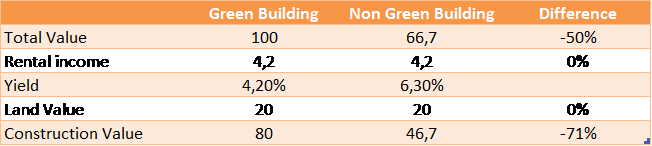
As a result of the IPD data, you can determine in a few minutes that the market offers a 71% premium for the value of a “Green” construction over a non-green construction.  At this stage it become clear what you want to build if you are a developper. The only economical explanation for such a premium would be that a green building will depreciate much slower than a non-green building. It would therefore deserve a premium as it would deliver returns on a longuer period of time.  
The table below, summarizes the number of years needed to collect enough rent in order to pay for the construction cost at a given unlevered expected return (the NPV of the cash flow is equal to zero).


What the previous table show is that If you expect a 5% return from a non green building, assumes no terminal value, no rental growth, no capex... you need to collect the rent for 16 full years. For a green building for which a 71% premium was paid, you need to collect rent for 54 years. Another way to say this is that the premium reflect the belief that the green building life will be 3,3 times longuer than the non green building.   

So now, here is the question: Which assets do you think is going to generate the most sustainable returns over time? I am not going to take position. However I have lost faith long ago in Hal Jordan and the believe that “Green is the color of will”

Apr 26, 2012

It's a wonderful life


An interesting development in the life of the open-ended fund industry has hit the news today. 

In a press release published today (http://aox.ag/IGAUNd), SEB ImmoInvest is trying to achieve what none of its peers dared to try before. Move from a bank run situation back to a stabilized situation.  They are doing so by pointing on to shareholders the actual consequence of the run. 

The last sentence of the press release that quotes current SEB Asset Management CEO goes as follow: 

Barbara A. Knoflach: “We are asking our investors to consider the alternatives and, by staying invested, to commit to a future of the fund that could very well live up to its successful 23-year track record. The only chance to avoid the liquidation of the fund with all its consequences is not to take advantage of the exit offer.”

I would like to state clearly that this is a very brave move, and indeed, in my view, the only way to put any of the closed funds back into action. 

I have discussed in a previous post the interesting game theory issue that the closure of open-ended fund closure was posing (http://aox.ag/JpQleh). Any one who took the time to run this game would have figured out that this could only work out positively if players increased COOPERATION. This is exactly what SEB is trying to do. Again that is the right thing to do. 

However, I need to point out to one major weakness in the way this is done. There is a lack of clarity on the potential outcomes for each scenario (going concern or liquidation). For cooperation to work and players to see a benefit in cooperation they need to understand that cooperating in the game will lead them to a higher benefit (payout) that acting individually (which in this case end up in a run). While to some extend this is suggested by the press release (the liquidation of the fund AND ALL ITS CONSEQUENCES) it is not explicitly said that a run will probably end up in a much lower payout… To the contrary its insist on the quality of the underlying portfolio as an argument to keep the fund running.  If holders believe that they will get the same value in liquidation than in a going concern, than the cooperation will simply not work. 

I do not know any real life example of any thing like this being done before on such a scale (but would be interested if anyone have any knowledge of this). I can however recall James Steward managing to save its bank with 2.000 dollars in the 1946 It’s a wonderful life movie. Looking back at the scene of the bank run might be a good idea, to understand how he got people to cooperate… http://aox.ag/Ijy0Rn

Apr 20, 2012

Forward looking statement

An interesting white paper published recently by Collier International went un-noticed, while I believe it deserve some attention and reading by anyone who is interested in the European office market.
The white paper is the third issue of a series called “Generation Y: Space planning and the future of workplace design”. Below this (un)inspiring title lies an interesting tentative calculation of the future demand for space in Europe (full document: http://aox.ag/Jyf8cg)
Collier equation is quite simple. They consider office workers population trend considering population growth, and remote working trends, as well as new workspace design trends, and add up the numbers.
The result of this analysis for an office hosting 200 employee in 2012 is summarized in the table below:

Colliers come to the conclusion that between now and 2030 it is likely that we will need 2% more office space than today. This is not an annual growth number; this is the total growth expected between now and 2030. The annualized growth rate would be around 0.07%. Let’s round it to ZERO.
The methodology used by Colliers can clearly be questioned. It is rather simplistic, and I am sure any academic can come up with a much more sophisticated econometric model in order to try to assess the need for office use in the future. However, the mere fact that it is simple does not means that it is pointing into the wrong direction.
In fact this analysis fit relatively well in the empirical evidence we have been gathering for years from the market. The existing building environment for commercial office space is sufficient in all the advanced economy. We do not need to build new space, but need to improve the existing one to fit better standards. Local government will have a significant responsibility as by granting building permits to build new office space. If in parallel they do not act to remove the same amount of space elsewhere, they are slowly but surely planting the seed for future vacancy. If in doubt you can have a look at the Nederland, or certain cities in Eastern Germany…
We have also argued in the past that this trend should not necessarily be considered as a bad trend for listed real estate company. Business models will surely need to adapt. Just being there is likely not to be enough anymore. None of the existing office property company anywhere in Europe has such a dominant market share, that it actually needs a growing market in order to pursue it own growth. It is however very likely that capital alone is not going to do the trick anymore. Emphasis is going to move slowly but surely from capital to operation. Listed companies are usually better prepared to face these challenges, than any other player in the market. They usually integrate the full real estate value change and can therefore identify change earlier than others and react faster.
The move is happening as we speak. As usual in our industry it is happening slowly. Don’t be mistaken by the lack of wave on the surface, this change is fundamental. I do not know whether or not Colliers is right in estimating the numbers of sqm of office space that will be needed in the future. However I do know that whoever will do my job in 2030, will be facing a completely different industry. With hopefully a number of more professional and bigger listed real estate companies.

Apr 17, 2012

Point of view

Following the publication of our latest annual reports we had a number of discussions with some analysts and investors (as we did last year for that matter) with respect to the write-off in value that we have published on our short leased assets.
We usually argue that from our perspective we would offer a lower price for a vacant building than we would for the same asset with a one year lease, which in turn should be cheaper than the same building with a two years lease … We always felt it makes a lot of sense to reflect this into our valuation process, and thus devalue every year the short dated assets to reflect the shorter lease term.
A recent article published by property magazine international (http://aox.ag/Ii71mp) is bringing a new perspective to the subject, based on a recent IPD analysis (this is the IPD Press release http://aox.ag/HVdOBX).  
According to IPD (as quoted by the article), UK landlords who give tenants five years leases immediately wipe out almost 2% of the value of their building.
Quote: “IPD lease length analysis shows that signing a new five year lease leads to a fall in value of around -1.8%, despite the property being let.”
Let’s all take a deep breath and step back for a minute to look closer to what IPS is suggesting here? If I read this correctly, the valuation of building which have signed a new five year lease (so which obviously were vacant or closed to be vacant) have LOST value because of the new lease. In other word, if investors would have paid 100 for a vacant building, they would only pay 98 for the same building with a five year lease. In essence, you would be better off keeping the asset vacant, rather than signing a short term lease. I don’t know about you, but this does not pass my smell test.
I might have a very twisted mind, but I would like to suggest another explanation for the whole story. What if the initial valuation of the building was wrong? What if the asset was never worth 100 in the first place? What if the new lease has shown beyond dispute that the assumption to get to the 100 value cannot be hold on to? Can it be that if the building was initially worth only 90 or 95, then the 5 year lease did increase the value to 98?   
From where I stand, in 99% of the cases, a cash flow producing asset is going to be worth more than the same asset vacant. Regardless of the length of the cash-flow. As such, we do devalue our assets when they are close of becoming vacant and we do show an increase in value when leases are renewed.
Where do you stand?

Apr 10, 2012

To go please !

I have been trying to figure out how to improve the utility management process of the company for quite a while now. This topic is important for us for a number of reasons, and I am deeply convinced that we need to find the right way to address this while time is still on our side. Not only managing utilities is the main way to improve sustainability credential of an asset, but utilities represent the bulk of our tenant costs. Any extra cents going to utility providers is a cent that we cannot use to increase the rent. On a longer timeframe consideration, I do believe that the future of leasing will be (as it is already in some Nordic countries) in the full service rent were utility costs will be borne by the real estate owner, rather than by the tenant. 

The existing “In Use” certification systems remain relatively weak and rely on little evidence of operation excellence. We have recently acquired a Bream in use certified asset, and I still struggle to see, what was better in this asset than in other non-certified assets. As far as I can tell (and I do not pretend to know all of these certification tools), having an “In Use” certification, could compare to changing the regular windshield cleaning lotion of your 4x4 SUV (18 liters/100 km) into an environmental friendly lotion, and argue that thanks to this new lotion on your SUV is “Green in Use”.

One of the bigger hurdles commercial real estate is going through with respect to improved utility management is in my view the “short” average ownership/management continuity that drives of industry. As I have argued before, real estate time is much slower than capital market time. Short ownership for a real estate is in my view anything between 5 to 7 years. Most of the investment that would be needed in order to measure and understand what is going on with a building would have a longer payout period. Without such measurement, and understanding, there is little you can do. More importantly, it is very unlikely that any buyer of the asset would pay for this specific piece of technology. The likelihood that a new owner system would be compatible with yours is very close to zero. The result is that most real estate owners underinvest into modern tools that would allow a better grasp on utility bills of building, as they will not capture enough benefit of the investment over its holding period. I am still confused, that I am able to know instantly that Lady Gaga changed its dress (@ladygaga on Twitter), our buildings are not able to communicate real time data. Not that the technology is lacking, but the cost of the technology is prohibitive within our potential ownership timeframe.
What we would need is a technology that would allow us to plug something into an existing metering system, and then be in position to take that something away with us whenever we would sell the asset to someone else. This would ease the investment decision, as the lifetime of the investment would not be tied up to a single asset but to the “plug and play” device itself. The good news is that there are a bunch of start-up companies out there that are developing just that. It is early development stage, lot of progress to be made, but definitively going into the right direction. We will be looking into that closely to see if it can really work. Monitoring “to go”, is what we really need.

Feb 16, 2012

More than a thousand words


This is probably not really worth a press release, but i though I could take a few minutes to write about it on our blog. Our AltePost development project has been selected to run for the MIPIM award in two categories this year. As the best Refurbished Building, and the Best German Project.

It is a very nice recognition for what was a five year hard work for our team as well as our partners (although for them it was only three years work). This development is one of which a young company like alstria can be proud of. It demonstates that you can acheive eventually please a lot of people with divergent interest, as long as you have the right approach and the right asset.

The first stakeholders of this development where the citizen of Hamburg which were concerned about the look and feel of the area shaped around this asset. This concern was convayed to a certain extend by the Monument Protection authorities that insisted on a number of things to be done. As a developper you usually hate this, but as a citizen, they did a great job. Just looking at the people wandering around the asset, and looking at its new design is a testimony of the successful repositioning of this lamdmark asset in the heart of both the City and its citizens.

Tenant are also by definition large stakeholders, and the challenge of bringing this asset to modernity while keeping it 170 years old soul, was acheived successfully as testified by the fast leasing success of the asset and the unique quality of its tenant base.
And last but not least, our shareholders and the one of our partners also had a vested interest in this project. In essence you can easily acheive to satisfy the first two stakeholders above, if you spend enough money on the building. In the case of AltePost, the result yielded to our shareholders where also outstanding.

Theses results where only acheived through the work of the project team of this development which involved us, and our partners Quantum and Stenham. Market movements had nothing to do with the success of this project. It is also a testimony of what we stand for and what we believe in. Real estate is about work. Do not expect market to help you to grow. Growth only comes through hard, usually long, and alway exiting work.

All in all this project explains more than a thousand words how our approach to real estate management.

For the first time this year, the MIPIM is offering the public to vote for their prefered project. If you feel like it, you can vote for AltePost here (http://aox.ag/A7tYwp)

Sep 30, 2011

I love it when a plan comes together!

European leaders might or might not be putting together CDO² in order to save (or kill for that matter) the Eurozone. The ECB might or might not become a large hedge fund. European banks might be under-capitalized (from what we can see it is fair to say that at least their real estate loan book is nowhere close where it would need to be). The US are facing huge budgets constrains while US politics seem just as reliable as Europeans. Maybe, or maybe not, but there is nothing much we can do about all of this.
The capital market sentiment seems to be back in 2008. Sell side analysts are focusing (again) on debt covenant, short tern refinancing, and other liabilities on companies balance sheet. We hear that this time it is different. This time banks have learnt their lessons, and will call loans…
The key question is shall or shouldn’t be worried about all of this. Well clearly the Eurozone uncertainty and lack of political leadership is something that we feel relatively worried about. As a German company solely investing in Germany alstria’s fate is link to Germany’s fate. We knew that, and have no intention to change this.  On the positive side, we feel that on a relative basis, we should be (at least in the beginning) doing better than other European countries. Being German is not so bad after all (being French citizen I feel I know what I am talking about here).

If you forget about all the macro noise, then it is fair to say that the market is exactly where we thought it would be by now. We have been openly communicating (including on this blog) and acting on the assumption that the years 2012 to 2014 would be tough real estate years. Mainly as a consequence of the amount of debt still in the system to be refinanced. In the beginning of 2011 we have written to our shareholders:
The years 2011 to 2014 are still going to be challenging years for a number of real estate owners. Debt overhang, overleverage, lack of equity capital: there are still a number of issues that need to be addressed one way or the other in the market. These tensions will, however, provide significant market opportunities for well capitalized companies with strong operational focus. We have been working for the last three years to position alstria for this exact moment. Now will be the time to reap the benefit of this work”.


So from this perspective the current situation and the concern around debt availability should not really come as a surprise.  We have successfully used the three previous years to reduce debt level on the company’s balance sheet, and reinforce its operational capability. We were expecting a bumpy ride. So we are very confident when it comes to sailing into the bumpy weather.  

I used to love the A-tean when i was a kid. Even when it all looked very bad, every episode ended with Hannibal saying : "I love it when a plan comes together!". It all come down to how good the plan is...

Aug 27, 2011

No excuses

You do not have enough time to read alstria's blog? You can access it now from your iphone via alstria's app. It available following this link http://itunes.apple.com/us/app/alstria-reit-ag/id451830672 or look for alstria in the appstore directly on your iphone...

A preview of what the app does is available at the following link: http://alstria.webuda.com/

So from now on, there is no excuses.